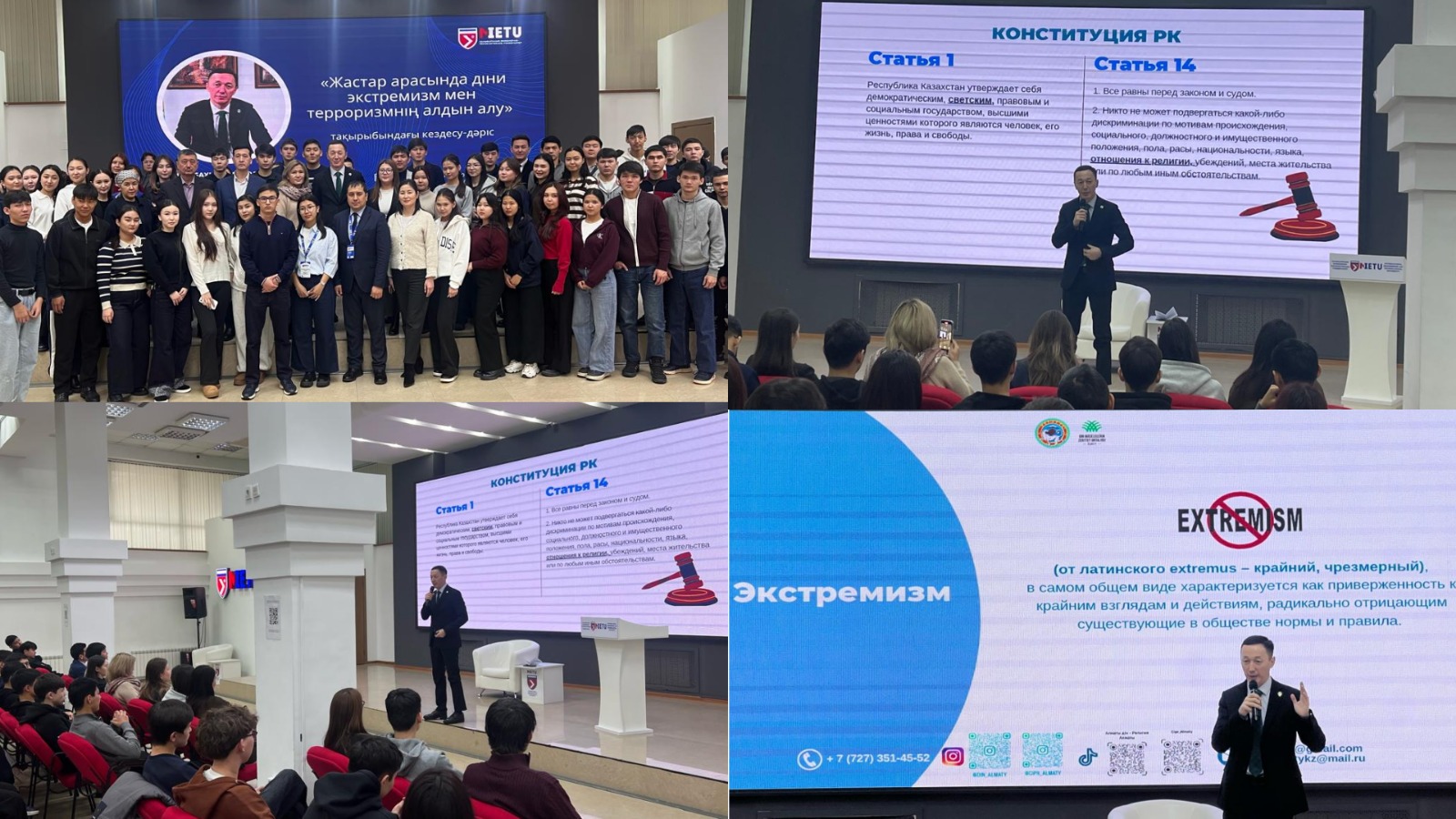
Preventing Religious Extremism and Terrorism Among Youth: Strengthening Legal Awareness and Secular Values
An informational and
awareness-raising event dedicated to the prevention of religious extremism and
terrorism among young people was held at the International Engineering and
Technological University. The event was jointly organized by the Department of
Social and Humanitarian Disciplines and World Languages and the University’s
Youth Policy Department. The main objective of the meeting was to enhance
students’ legal and religious literacy, explain the dangers of radical
ideologies, and reinforce secular values within society.
The invited speaker, Bakhytzhan
Zholdybayuly Saparov, a lawyer, PhD holder, member of the Almaty City
Information and Outreach Group, and a scholar of the international “Bolashak”
program, delivered a comprehensive lecture. The presentation began with an
overview of the constitutional foundations of the Republic of Kazakhstan as a
secular state and addressed issues of freedom of conscience and equality before
the law. The speaker emphasized that secularism is not an anti-religious
stance, but rather a legal framework aimed at ensuring peace, stability, and
interfaith harmony.
Based on the presentation
materials, clear legal definitions of religious extremism and terrorism were
provided, along with explanations of their key characteristics and the threats
they pose to society. Particular attention was paid to the objectives of
extremist movements, which seek to undermine state authority, national
security, and social stability. The speaker also reviewed the main legal acts
of the Republic of Kazakhstan regulating counter-extremism and
counter-terrorism efforts and outlined the criminal liability established for
such offenses.
A significant part of the lecture
focused on methods used to recruit young people into radical religious
movements. Special emphasis was placed on online recruitment through social
networks and digital platforms, as well as manipulative practices and the
misuse of pseudo-religious narratives. The speaker highlighted the importance of
obtaining religious knowledge exclusively from official and lawful sources and
maintaining vigilance regarding personal and information security.
The event was attended by
academic advisors and students from the Departments of Food Production
Technology and Engineering, Economics and Business, and Biochemical
Engineering, as well as college instructors and the university’s compliance
officer. The meeting was conducted in an interactive format and concluded with
a question-and-answer session. Students actively engaged by asking questions
about identifying extremist content, early signs of radicalization, legal
consequences, and appropriate actions in questionable situations. All questions
received clear and detailed responses.
The event served as an important preventive
platform aimed at countering extremism and terrorism among youth. Such
initiatives contribute to the development of students’ civic responsibility,
deepen their understanding of the principles of a secular state, and promote
social stability and security. The International Engineering and Technological
University intends to continue implementing systematic awareness-raising
activities within its youth policy framework, fostering a conscious and
responsible younger generation.