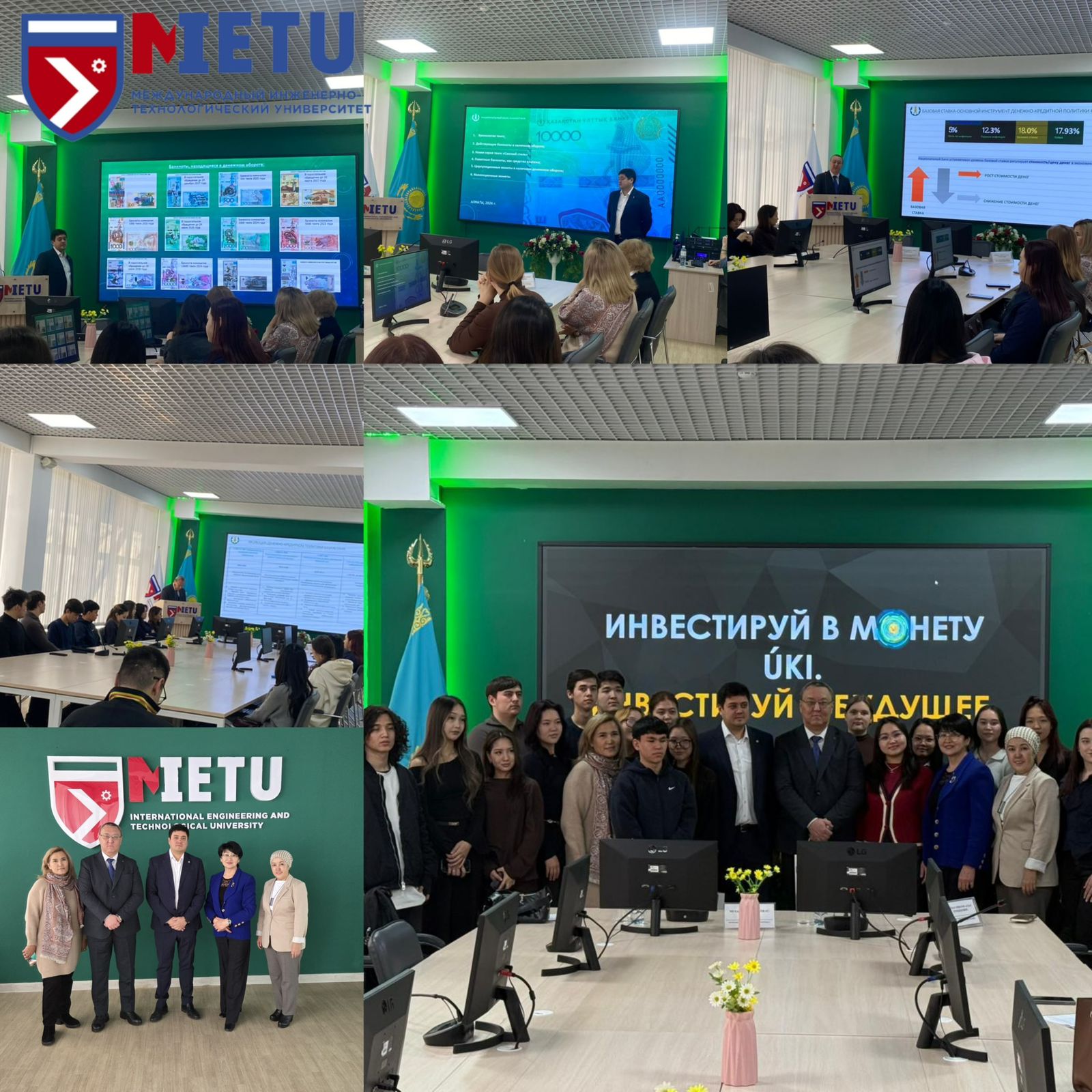
An financial literacy master class was held at the International
Engineering and Technological University (METU) for students of the Finance and Accounting and Auditing educational programs, organized with the
participation of representatives of the Agency of the Main Branch of the
National Bank of the Republic of Kazakhstan (AMF NBRK).
The organizer of the master class was Kuralay Kadyrkulovna Berdimuratrova, Master of Economics, Lecturer
of the Department of Economics and Business.
During the event, current issues related to the functioning of the monetary
and credit system and ensuring the financial stability of the state were
discussed.
A presentation on the topic “Monetary
Policy” was delivered by Olzhas
Damirovich Mukhamedyanov, Head of the Department of Economic Analysis
and Statistics of the AMF NBRK. In his speech, the speaker thoroughly explained
the goals and instruments of monetary policy, the role of the National Bank in
maintaining price stability, as well as the impact of macroeconomic decisions
on the financial market and the national economy as a whole.
The topic of the national currency
of the Republic of Kazakhstan aroused particular interest among students.
During the master class, the chronology of the development of the tenge was
presented, current banknotes and the new “Saka Style” banknote series were reviewed, as well as
commemorative coins and their significance for the development of financial
culture and the investment market.
A separate session was devoted to modern investment instruments. Askar Turebekovich Tokmagambetov, Head
of the Department for Cash Handling and Cash Operations of the AMF NBRK,
presented the investment product Gold
Coin, explaining its features, advantages, and opportunities for use as
a tool for capital preservation and growth.
During the master class, students demonstrated high activity and asked
insightful questions related to financial
literacy enhancement, prevention
of financial fraud, protection
of consumers’ rights in financial services, and practical aspects of the
functioning of the financial system. The lively dialogue with specialists from
the National Bank allowed students to deepen their professional knowledge and
acquire valuable practice-oriented skills.
The event made a significant contribution to the development of students’
financial culture and to improving the quality of training of future
specialists in the fields of finance
and accounting and auditing.