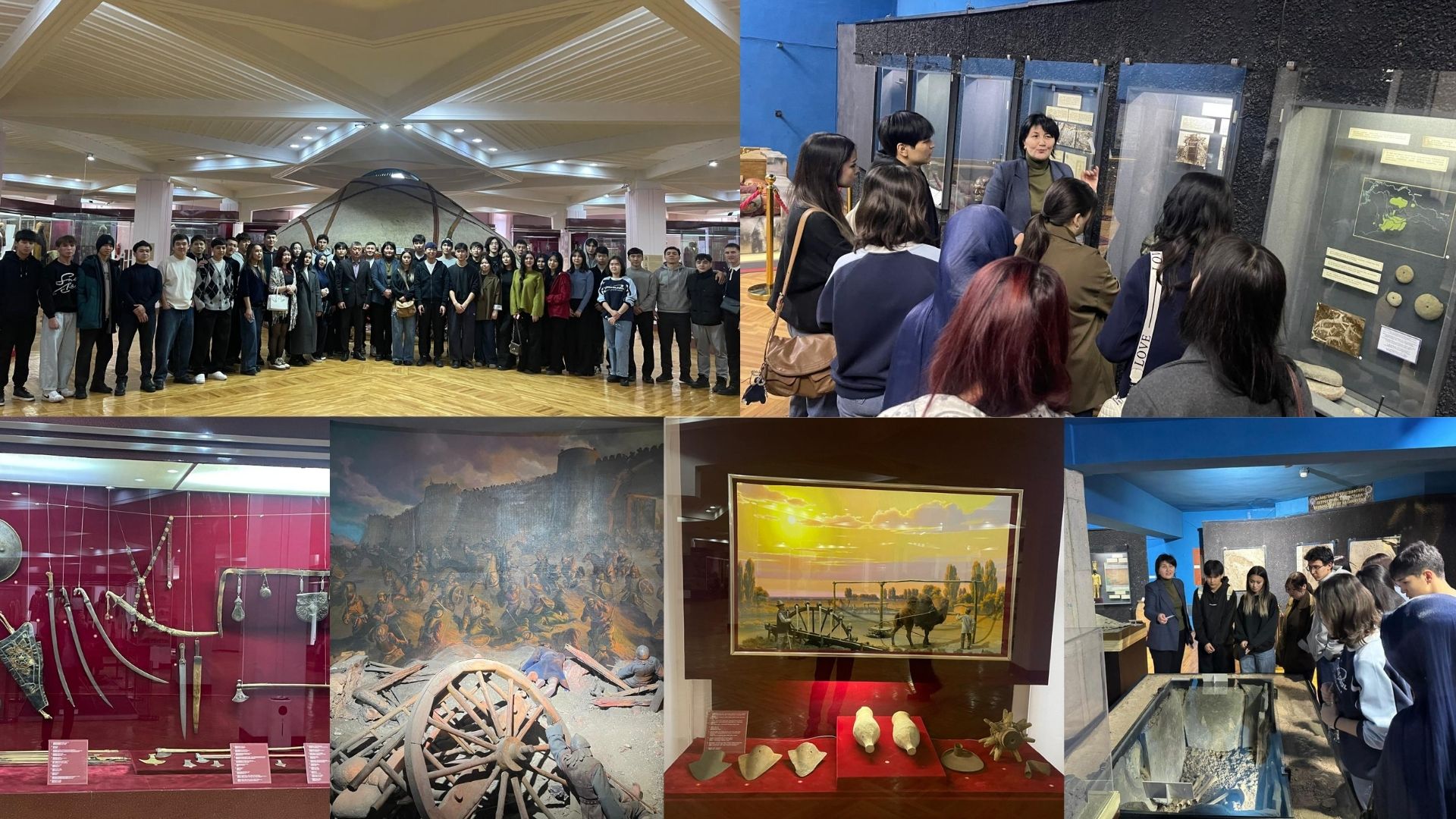
Field Lecture on the Course “History of Kazakhstan” Held at the Central State Museum of the Republic of Kazakhstan
In order to enrich the
educational process with practical content, enhance students’ historical
thinking, and effectively utilize museum space as an educational environment, a
lecture on the course History of Kazakhstan was conducted in the format of a field lecture at the Central State Museum of the Republic of Kazakhstan.
The field lecture format
enabled students to study historical material outside the traditional classroom
setting, engaging directly with authentic archaeological, ethnographic, and
paleontological sources. This approach facilitates the integration of
theoretical knowledge with visual museum exhibitions and promotes a holistic
and systematic understanding of historical processes.
The lecture began in the Hall of Paleontology and
Archaeology, which consists of two major exhibition
complexes—paleontological and archaeological. The exhibition reflects the
long-term development of humanity shaped by natural and anthropogenic factors.
Its conceptual framework is based on demonstrating causal relationships and
interdependence between the natural environment and human society.
The paleontological section
presents rich osteological materials, petrified trees, and imprints of insects,
fish, and plants preserved in shale formations. A significant portion of the
exhibits dates back millions of years. The paleontological collections are
arranged chronologically according to geological periods, clearly illustrating
the evolutionary development of the Earth.
The archaeological exhibition
complex covers the Stone Age, Bronze Age, Early Iron Age, the Hunnic-Sarmatian
period, the Middle Ages, and historical stages up to the 15th century. It
provides comprehensive insight into the economic activities, social structure,
religious beliefs, and artistic culture of the peoples who inhabited the
territory of Kazakhstan since ancient times. The archaeological materials are
displayed on two levels of the hall, organized thematically and
chronologically.
Among the exhibits are unique
artifacts discovered during archaeological expeditions conducted across
Kazakhstan. Notable items include the scientific reconstruction of the “Golden
Man” from the Issyk burial mound, unique gold artifacts from the Kargaly and
Zhalauly hoards, reconstructions of ancient burial sites, as well as models and
dioramas of medieval architectural monuments. Weapons, horse harnesses, bronze
vessels, and ritual objects represent vivid examples of early nomadic culture.
Monuments of the Kangju
culture of Southern Kazakhstan are represented by artifacts discovered during
excavations of settlements and burial mounds along the Arys River (4th century
BCE – 4th century CE). The cultural heritage of medieval Turkic nomads is
illustrated through stone sculptures, warrior attributes, and elements of
military equipment.
During the lecture, particular
attention was paid to the formation and development of urban culture in
Kazakhstan, as well as to the consequences of the Mongol invasion. Events of
the 13th century, including the heroic defense of the city of Otrar, are
vividly depicted in the diorama “The Heroic Defense of Otrar.”
The next stage of the lecture
took place in the Hall of Historical Ethnography, whose exhibition covers
the history of Kazakhstan from the 15th century to the early 20th century. It
is dedicated to the traditional culture of the Kazakh people, including their
economic system, daily life, and spiritual worldview. The exhibition is based
on a scientific concept and reflects the socio-cultural characteristics of
Kazakh society.
The exhibition complexes
present key historical periods such as the formation of the Kazakh Khanate, the
development of statehood, resistance to Dzungar aggression, and the
incorporation of Kazakh lands into the Russian Empire. The hall features
authentic photographs, rare books, maps, household items, examples of folk
decorative and applied arts, national costumes, and a yurt as a symbol of
Kazakh culture.
The field lecture concluded in
the Third
Historical Hall, where the multi-ethnic culture of Kazakhstan
is presented through household objects, handicrafts, and photographic
documents. The exhibition introduces the cultural heritage of 16 ethnic groups.
In addition, the hall contains exhibitions dedicated to the heroism of
Kazakhstanis during the Great Patriotic War. The “Rear – Front” complex
highlights Kazakhstan’s contribution to the economy, science, and culture
during wartime, as well as the dedication of rear workers.
In conclusion, the field lecture held at
the Central Museum contributed significantly to the formation
of students’ historical consciousness, deepened their understanding of the
past, and facilitated the integration of theoretical knowledge with authentic
historical sources. This format represents an effective model for utilizing
museums as dynamic educational and research spaces.