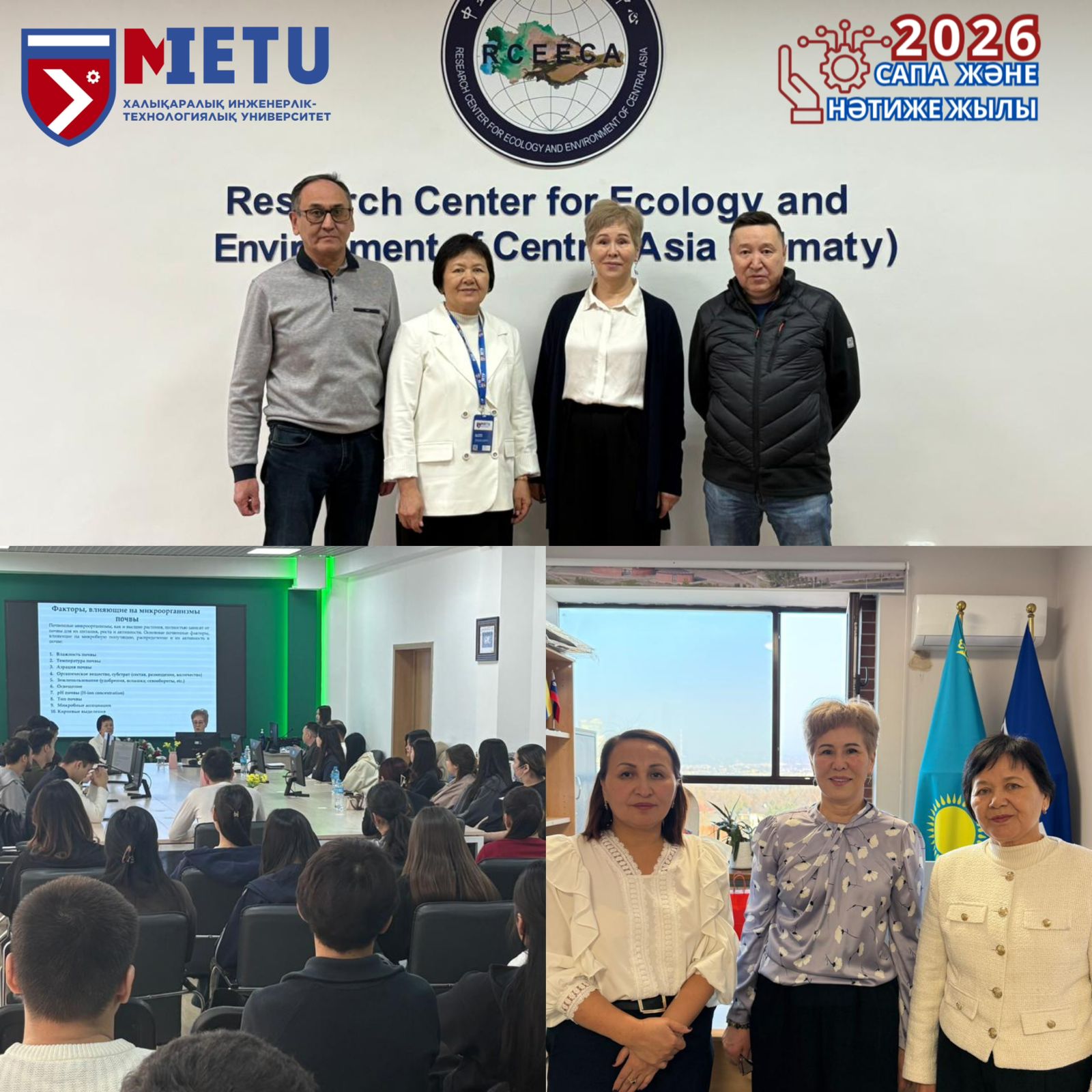
As part of the “Visiting Professor” program, METU was visited by Professor Elmira Rakhimovna Salnikova of the University of Belgrade
As part of the “Visiting
Professor” program aimed at developing international cooperation and academic
mobility, the International Engineering and Technological University hosted a
visiting professor from the University of Belgrade (Serbia) — Elmira Rakhimovna
Salnikova, Doctor of Philosophy (PhD), Professor, Doctor of Sciences in
Environmental Protection and Technologies, Research Professor at the Institute
for Multidisciplinary Research (Belgrade), from February 4 to 13, 2026.
During the visit,
Professor Salnikova delivered lectures and conducted practical classes for
2nd–3rd year students of the educational program “PIAP” in the
disciplines “Soil Fertility” and “Reclamation of Disturbed Lands.” The classes
addressed current issues of soil degradation, carbon sequestration, and modern
international approaches to the restoration of disturbed territories.
In addition, the
professor provided consultations for faculty members, master’s students, and
young researchers on preparing scientific articles for publication in
international peer-reviewed journals of Q1–Q3 quartiles, with particular
attention given to article structure requirements, journal selection, and
increasing publication activity.
As part of the visit
program, Professor E.R. Salnikova, together with A.B. Abuova, Head of the
Department of Technology and Processing of Food Products, visited the U.U.
Uspanov Institute of Soil Science and Agrochemistry, where prospects for
further scientific cooperation and possible areas of joint research were
discussed.
Following the
meetings, with the assistance of the visiting professor, an agreement was
reached to prepare and conclude a cooperation contract with Galymazhan
Abdullaevich Saparov, General Director of the Research Center for Ecology and
Environment of Central Asia LLP.
The visit of the
invited professor contributed to strengthening international partnerships,
expanding scientific collaboration, developing joint research projects, and
increasing the interest of students and young scientists in modern
international research areas.