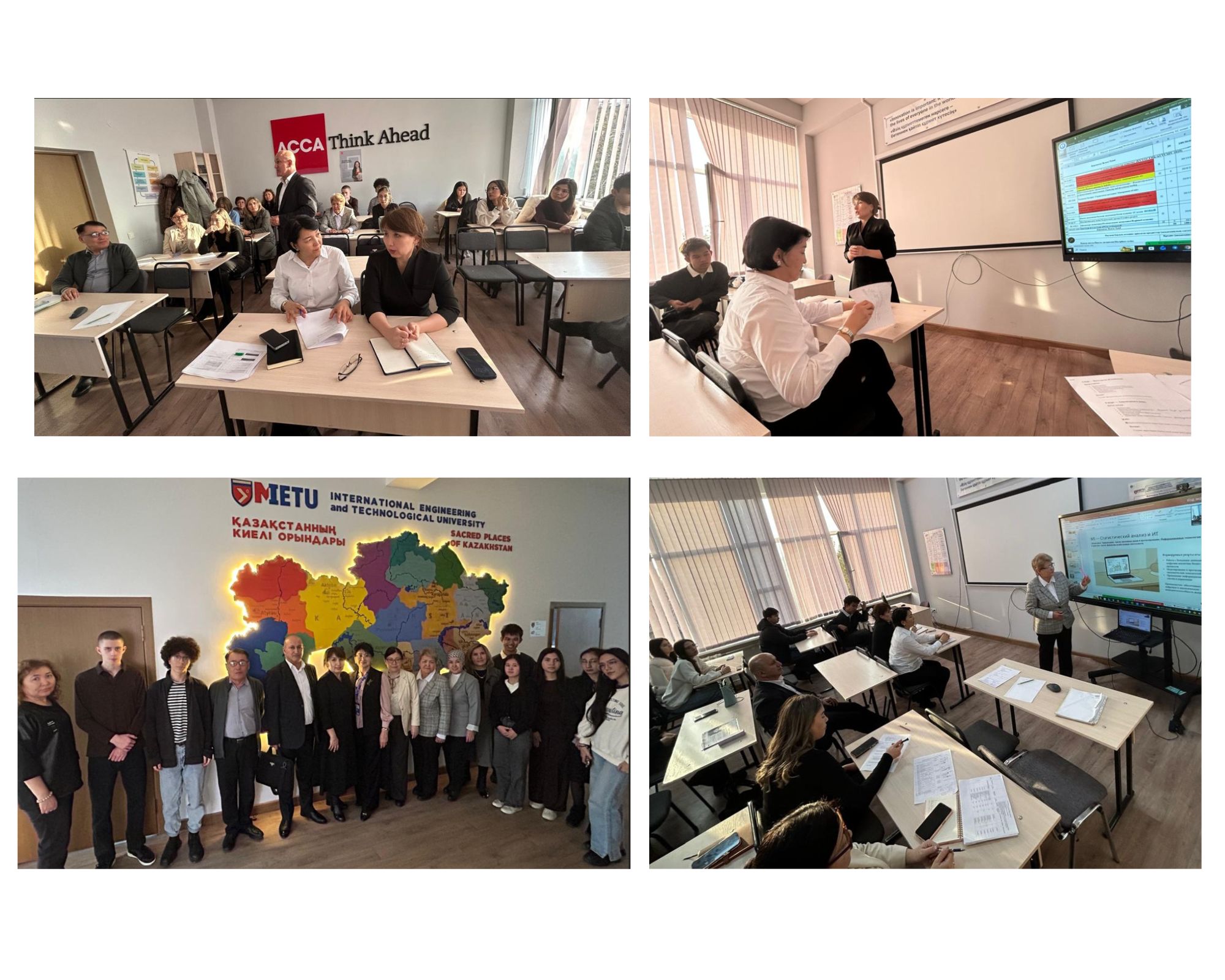
Discussion and Enhancement of the Educational Program 6B04105 – Information and Innovative Technologies in Economics with the Participation of Teachers, Experts, and Students
On February
18, 2026, MITU held an open session of the Academic Committee for the
“Information and Innovative Technologies in Economics” program. The meeting
focused on updating the curriculum in line with labor market requirements,
digital economic transformation, and professional standards.
Employers,
faculty, academic experts, and students participated. Updated courses were
presented, and discussions included introducing new subjects, enhancing
practical training, and expanding cooperation with the business community.
Zh.D.
Osmanov, Director of the Center for Applied Research, noted that the IITE
program combines economic and IT disciplines, and graduates with these
competencies quickly find employment. He suggested strengthening the analytical
component and replacing some financial courses with economic ones, such as “Global
Financial Market” with “Enterprise Economics.”
Professor
A.N. Toksanova justified the introduction of the course “Feasibility Study and
Financial-Economic Project Modeling” to develop students’ competencies in
evaluating investment and business projects.
Vice-Rector
for Academic Affairs and International Relations, A.A. Abdildaeva, explained
that when drafting the RUP, current regulations and mandatory courses are
considered to ensure compliance with educational standards.
Head of the
Department of Software Engineering, M.Zh. Sakypbekova, proposed adding
“Business Analytics and Big Data” to the “IT Technologies and Digital
Transformation” track to develop skills in big data analysis and managerial
decision-making.
Students
highlighted the practical orientation of the courses and their active
participation. The committee emphasized working with real company cases and
startup projects to strengthen the practical component and develop students’
research skills.
Zh.T. Dildebayeva, Head of the Department of Economics and Business,
expressed her gratitude to all participants — teachers, experts, employers, and
students — for their active participation, constructive suggestions, and
contribution to the development of the educational program. Such meetings
contribute to improving the educational process and enhancing the quality of
specialist training.