SCIENCE AND TECHNOLOGY IN THE ERA OF ARTIFICIAL INTELLIGENCE: THE DECADE OF SCIENCE OFFICIALLY LAUNCHED
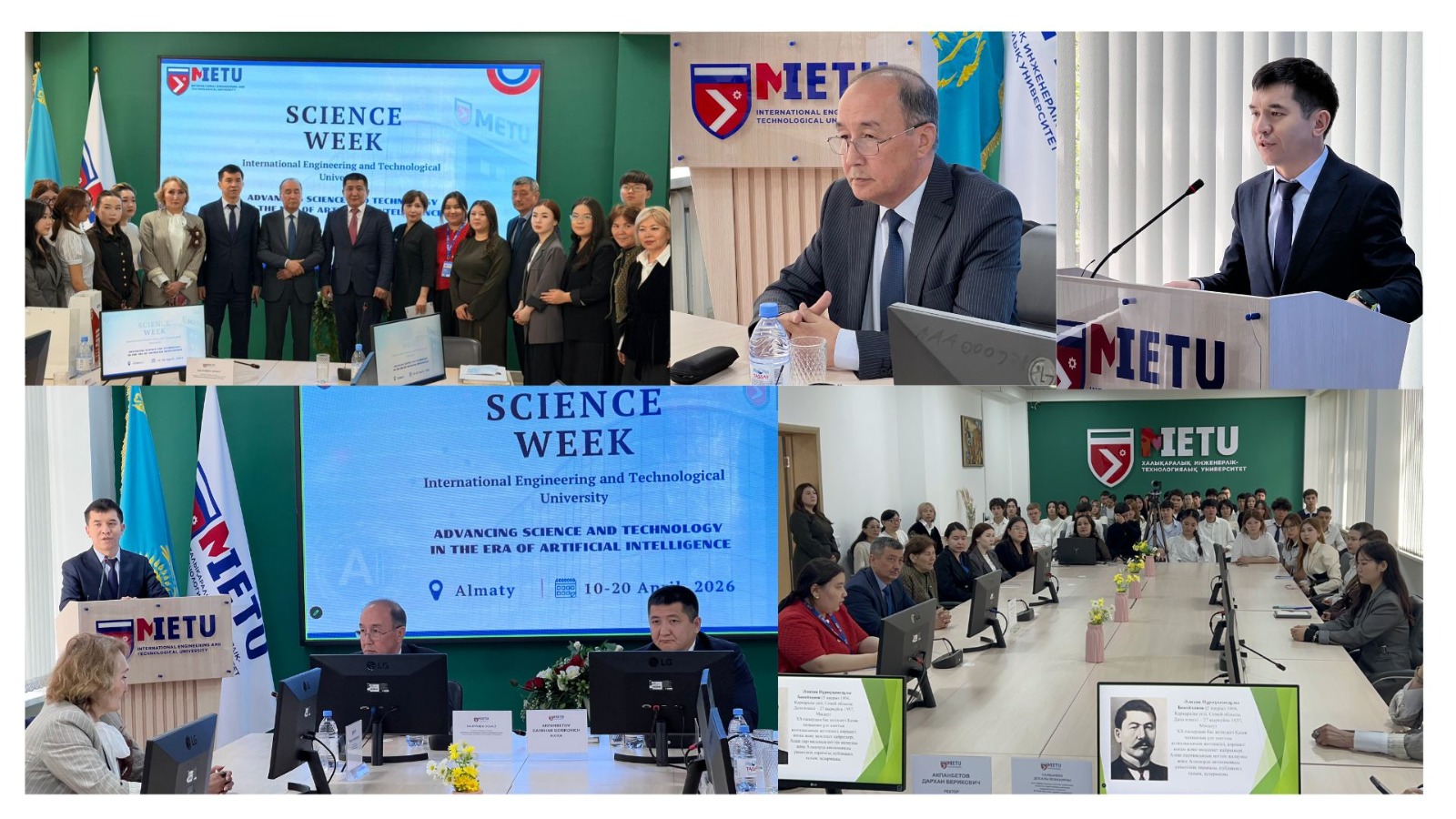
On April 10, 2026, the
International Engineering and Technology University officially launched the
Decade of Science under the theme “The Development of Science and Technology in
the Era of Artificial Intelligence.” This large-scale academic event was
organized at a high level and marked an important milestone reflecting the
university’s scientific and innovative potential.
The opening ceremony was inaugurated by the Rector of the
University, Darkhan Berikuly Akpanbetov, who personally oversaw both the
organization and the substantive direction of the event. In his address, the
Rector highlighted the new directions of scientific development in the era of
artificial intelligence, emphasized the role of innovative technologies, and
outlined the strategic priorities for strengthening the university’s research
activities. His speech defined the conceptual and intellectual framework of the
Decade of Science and set clear guidelines for the events to follow. The
ceremony brought together the university leadership, faculty members, the staff
of the Department of Social Sciences and World Languages, as well as students
and young researchers. This clearly demonstrated the academic community’s
readiness to engage collectively in discussing the pressing scientific
processes and challenges of the present day.
The key event of the first day was a guest lecture
entitled “Alikhan Bokeikhanov and the Alash Intelligentsia,” which served as
the opening and intellectually significant component of the scientific program.
The lecture was delivered by Candidate of Historical Sciences, Professor
Salkynbek Dosaly Isakhanuly. In his presentation, the distinguished scholar
offered a profound academic analysis of the historical significance of the
Alash movement led by Alikhan Bokeikhanov and proposed new interpretations of
its role in the history of Kazakh statehood. The lecture was distinguished by
its solid source base, theoretical depth, and effective integration of
historical issues with contemporary scholarly approaches. Professor Salkynbek
Dosaly Isakhanuly characterized the Alash intelligentsia as an intellectual
elite that played a crucial role in awakening national consciousness and
convincingly substantiated the significance of its legacy for contemporary
Kazakhstan. The lecture was delivered at a high academic level and attracted
considerable interest among students and young researchers. The discussion also
featured Zhandos Zhumalbekuly Kumganbayev, PhD, Associate Professor of the
Department of History of Kazakhstan at Al-Farabi Kazakh National University. In
his remarks, he emphasized the relevance of studying political parties and
movements of the early twentieth century and analyzed the continuity of the
ideas of the Alash movement in the context of contemporary academic research.
The first day’s program continued in an interdisciplinary
format and included guest lectures, an intellectual hackathon, and
bioengineering workshops. In particular, an online guest lecture entitled
“Spiritual Traditions in the History of Turkic Peoples” was delivered by
Professor Mehmet Emin Şen of the Faculty of Humanities and Social Sciences at
Suleyman Demirel University (Isparta). In addition, a substantive lecture on
“Intelligent Medical Devices and Sustainable Development” was presented by
Chingiz Abdraimovich Alimbayev, PhD, Associate Professor and Corresponding
Member of the National Engineering Academy of the Republic of Kazakhstan. These
activities clearly demonstrated the interdisciplinary nature of the scientific
agenda and the university’s commitment to the comprehensive development of
science and technology.
Overall, the Decade of Science includes a broad range of
academic events. Specifically, on April 13 a round table and scientific
seminars devoted to the development of research capacity will be held; on April
14–15 open lectures, scientific seminars, and competitions for young
researchers will take place; on April 16 the international scientific and
practical conference entitled “The Quality and Effectiveness of Science in the
Era of Artificial Intelligence” will be organized; on April 17 the official
opening of the university’s Advanced Technology Center and an exhibition of
scientific achievements are scheduled; on April 17–18 a technological hackathon
will be held; and on April 20 an open lecture by an international-level
speaker, along with the closing ceremony of the Decade of Science, will take
place.
Thus, the ceremonial
opening of the Decade of Science marked an important stage in the development
of the university’s academic life and launched a fundamental scientific
platform systematically organized under the Rector’s leadership. From the very
first day, the event demonstrated a high level of organization and intellectual
content, while the academic depth of the guest lecture clearly indicated that
the subsequent events of the decade would also be held to a high scholarly
standard.