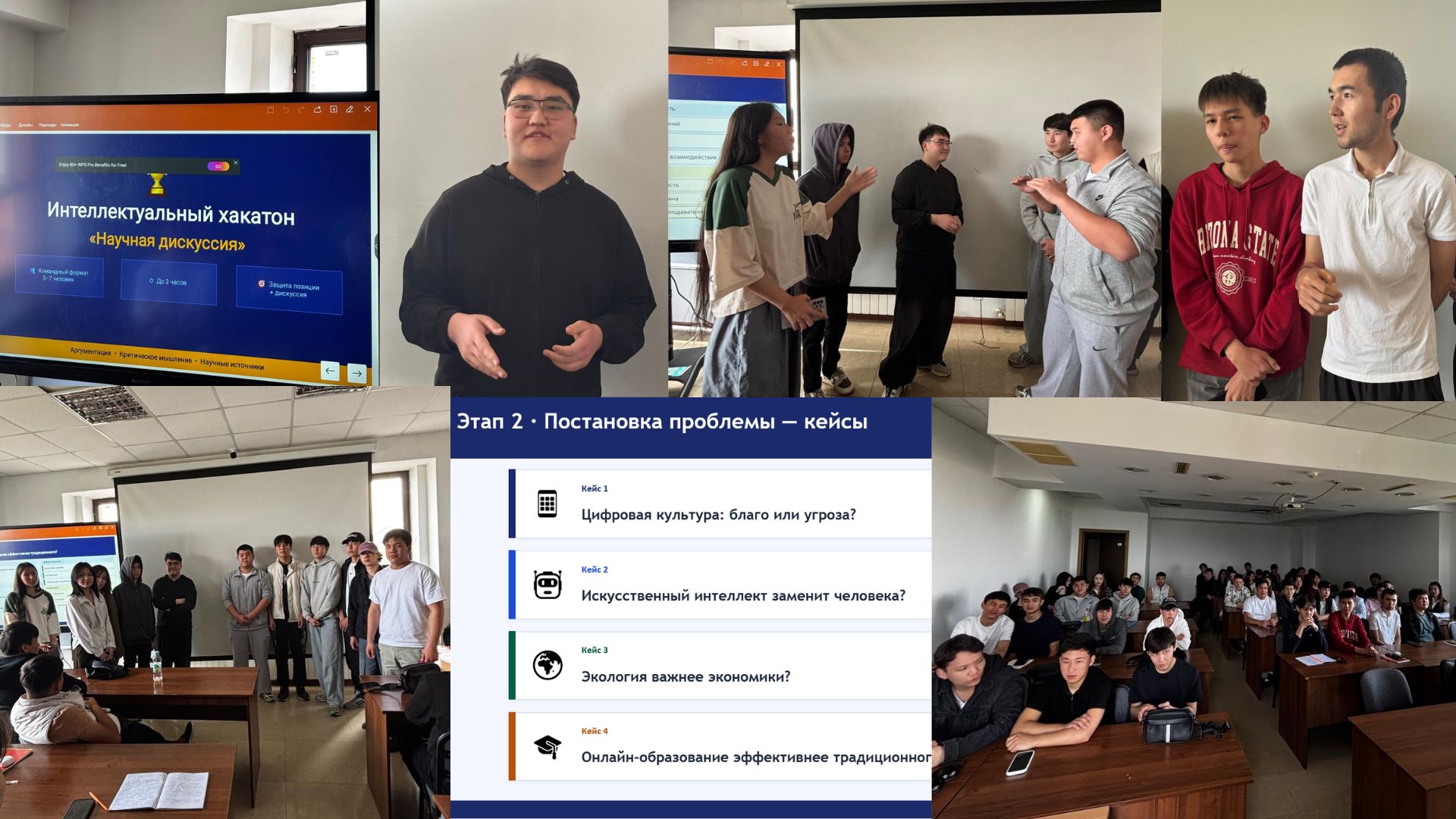
Intellectual Hackathon "Scientific Discussion” among First-Year Students of METU
On April
27, 2026, lecturers of the Department of Social and Humanitarian Disciplines
and World Languages, Tsyrenzhapova G.G. and Nurmoldaev D.M., conducted an
intellectual hackathon titled “Scientific Discussion” among first-year students
enrolled in the educational programs “Software Engineering,” “Information and
Innovative Technologies in Economics,” and “Accounting and Audit.”
As part
of the event, student teams were presented with relevant problem-based cases, including: “Digital Culture: Benefit
or Threat?”, “Will Artificial Intelligence Replace Humans?”, “Is Ecology More
Important than the Economy?”, “Is Online Education More Effective than
Traditional Education?”, “Should Social Media Be Restricted?”, and “Is Genetic
Engineering Acceptable?”
The main
objective of the hackathon was to develop key academic competencies: skills in
scientific argumentation, critical analysis, academic discussion, and working
with scholarly sources.
After
randomly selecting their topics, teams formulated theses, gathered scientifically
grounded arguments, analyzed sources, and prepared presentations. The final
stage involved defending their positions on the selected issues, followed by
participation in a scientific discussion.
Based on
the results of the hackathon, and considering the logical coherence and
scientific validity of the arguments, speech culture, and the ability to
conduct discussions in accordance with the principles of academic ethics, the
winners were determined in the following categories:
- “Best Opponent Team” – Team
“The Boys” (PI-25-1.7k);
- “Strongest Argument” –
Kuralbek Yerkin, student of group (PI-25-1.7k);
- “Best Speaker” – Mukhat
Yerzat and Alzhapbar Dilnaz, students of group (PI-25-1.3k).
The hackathon served as an effective platform
for developing analytical thinking, communication skills, and a culture of
academic dialogue, and also demonstrated the active engagement of first-year
students in scientific and educational activities.