REPUBLICAN PUBLIC ASSOCIATION
“NATIONAL ENGINEERING ACADEMY OF THE REPUBLIC OF KAZAKHSTAN”
National Engineering Academy of the Republic of Kazakhstan (NEA RK) is a large and reputable association coordinating and developing scientific and engineering activities in Kazakhstan. The foundation of the Academy`s high potential is its leading scientists and engineers of the country, production specialists, public officials, deputies of the Parliament of the RK, heads of central and local management bodies, higher education institutions, sectoral research institutes, industrial associations, enterprises and organizations of the public and private sectors of the economy. Honorary academicians and laureates of the NEA RK awards include prominent scientists and engineers from Russia, the USA, EU countries, Pakistan, Malaysia, Japan, South Korea, and other countries worldwide. About 150 research institutes, universities, joint-stock companies, companies, industrial enterprises, and organizations are members of the Academy as initiative members.
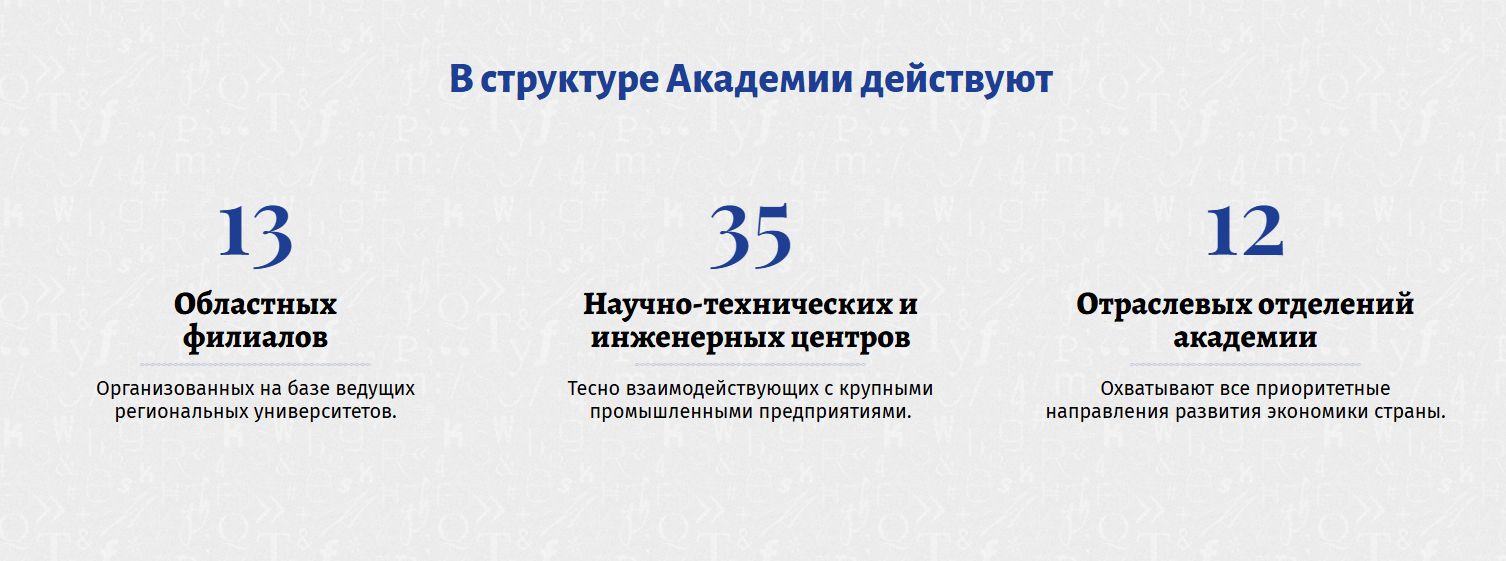
The Academy structure includes 12 regional branches established on the basis of leading regional universities, 35 scientific-technical and engineering centers closely interacting with major industrial enterprises. The Academy`s 12 sectoral divisions cover all priority areas of the country`s economic development: architecture, construction and building materials, computing and information technologies, geology and mining, agro-industrial engineering, mechanical engineering, space technology, petrochemical technologies, food industry, consumer goods, transport and communications, ecology, economics, energy and energy-saving technologies.
The Academy was founded in November 1991 as the Kazakh branch of the USSR Engineering Academy, which, with Kazakhstan gaining state sovereignty, was reorganized into the National Engineering Academy of the Republic of Kazakhstan. The founders of the Academy were the leading representatives of Kazakh science and engineering who made a significant contribution to the country`s economy, education, and science. Among the first initiators were A.A.Abdulin, K.M.Aukhadiev, S.M.Baibolov, U.B.Baimuratov, Sh.Kh.Bekbulatov, G.R.Bekzhanov, A.V.Bolotov, F.Kh.Galimov, U.A.Dzholdasbekov, A.Ch.Dzhomartov, B.T.Zhumagulov, T.Zh.Zhunosov, Kh.R.Kazyhanov, U.K.Karamanov, S.M.Kozhakhmetov, A.A.Kulibaev, N.K.Nadirov, B.G.Nurzhanov, M.E.Nurumov, B.P.Parimbetov, I.R.Polyvyannyy, O.S.Sabdenov, A.A.Skakov, S.T.Takezhanov, Ya.S.Tlevlesov, M.F.Urkumbayev, A.Usenov.
The President of the Academy is the prominent Kazakh mathematician, public official, academician B.T.Zhumagulov.
The activity of the National Engineering Academy of the Republic of Kazakhstan is aimed at systematically overcoming the gap between fundamental and applied science and production, turning science into a real productive force, the main source of innovations for the country`s technological development, effective reproduction of intellectual capital, and integrating science into Kazakhstan`s economy. The main task of the Academy is to ensure the increasing and effective participation of domestic science in implementing the unprecedentedly large-scale Strategy “Kazakhstan – 2050” proposed by the President – Leader of the Nation Nursultan Abishevich Nazarbayev, and the State Program for Accelerated Industrial-Innovative Development of Kazakhstan.

Project topic:
Construction and study of quaternion Fourier transformations and their application in creating information systems for geophysics and geochemistry tasks (IRN AP14871252)
Priority direction of scientific development:
Information, communication, and space technologies;
Specialized scientific direction, type of research:
High-performance computing technologies; Geographic information technologies and systems; Field of research: Natural sciences; Type of research: Applied research;
Scientific supervisor:
Project Scientific Supervisor – Temirbekov N.M., D.Sc. (Phys.-Math.), professor, corresponding member of NAS RK, NEA RK academician.
The project is carried out with grant funding for fundamental and applied scientific research under scientific and/or scientific-technical projects for 2022-2024, as well as with co-financing by GeoProject Corporation LLP.
Project topic: High-performance computer modeling of multiphase fluid flow in a porous medium under uncertainty conditions.
Existing methodologies for mathematical description of physical processes and effects often do not take into account the non-equilibrium and stochastic nature of multiphase fluid filtration. Meanwhile, the physical nature of the considered processes in a multicomponent (compositional) model, taking into account heat and mass transfer processes, depends on the condition of the overall equilibrium of all components and the moment of impulse influence on them.
Project topic: “Application of the concept of active knowledge, GAN to the task of building digital twins of public spaces to support decision-making in emergency situations”
Supervisor: PhD, Lebedev D.V.
Project topic:
Development and implementation of a high-performance parallel 3D numerical algorithm for the mathematical model of solid particle dynamics in large- and small-scale turbulent flow under non-isothermal conditions.
Object of study, development or design
The object of study is the dynamics of solid particles in large- and small-scale turbulent flow under non-isothermal conditions.
Main constructive and technical-economic indicators
Development and implementation of mathematical models of solid particle dynamics in high- and low-temperature turbulent flow in a gas medium, considering gas-solid interaction, creates prerequisites for specialists in biomedicine, ecologists, and production representatives to use simulation results for forecasting and assessing phenomena related to the transport of fine particles, dust, viruses, etc., in closed and open spaces. Mathematical modeling of such processes also contributes to a deeper understanding of some processes related to drug production.
Effectiveness
Development of mathematical models and their implementation will allow making recommendations on possible application of results in specific emergency situations, when pollutants are transported, particle movement occurs in enclosed spaces, and when studying substance propagation in open and closed spaces, in pharmaceuticals, production sector, etc.
Application area
Project research results may significantly impact the development of new technologies related to studying impurity transport processes in the atmosphere, drug production, spread of viruses in open and closed spaces, etc.
Project topic: Development of a geoinformation system module based on methods of intelligent anomaly detection for deep exploration of deposits (IRN AP08856012)
Project leader: Temirbekov Nurlan Mukhanovich, D.Sc. (Phys.-Math.), professor, vice-president of the National Engineering Academy of the Republic of Kazakhstan
Priority direction of scientific development: Information, telecommunication and space technologies
This project aims to create a software module of a geoinformation system based on methods of intelligent anomaly detection of hidden deposits for deep predictive exploration modeling. The module operates using the theory of inverse problems in mathematical geophysics, with geological data on the Earth`s surface, geophysical measurements, and geochemical analyses as input. The developed software module is based on a comprehensive predictive-mineralogical model consisting of geochemical and geophysical parts and digital modeling using inverse problems methods in geochemistry and geophysics, aimed at regional geological study of the Earth`s crust, especially its deep layers.
The project is implemented with grant funding from the Ministry of Education and Science of the Republic of Kazakhstan for 2020-2022, as well as co-financing by Dake Barlau LLP.
Project topic: Development and implementation of a new approach for determining rheological parameters of liquid-phase multicomponent systems using a new type of rheoviscometer (IRN AP08856723)
Priority direction of scientific development: Rational use of natural resources, including water resources, geology, processing, new materials and technology, safe products and structures.
Specialized scientific direction, type of research: Applied research in the field of chemical sciences.
Scientific supervisor: Mun Grigory Alekseevich, D.Sc. (Chem.), professor, academician of the National Engineering Academy of the Republic of Kazakhstan.
The project is implemented with grant funding for fundamental and applied scientific research under scientific and/or scientific-technical projects for 2020-2022, as well as co-financing by IP “Baipakbaeva”.
| +7 727 339 12 84 | |
| nia_rk@mail.ru | |
| 050060, Almaty, Khojanova St., 67, 6th floor |